The lack of metaphor is striking.
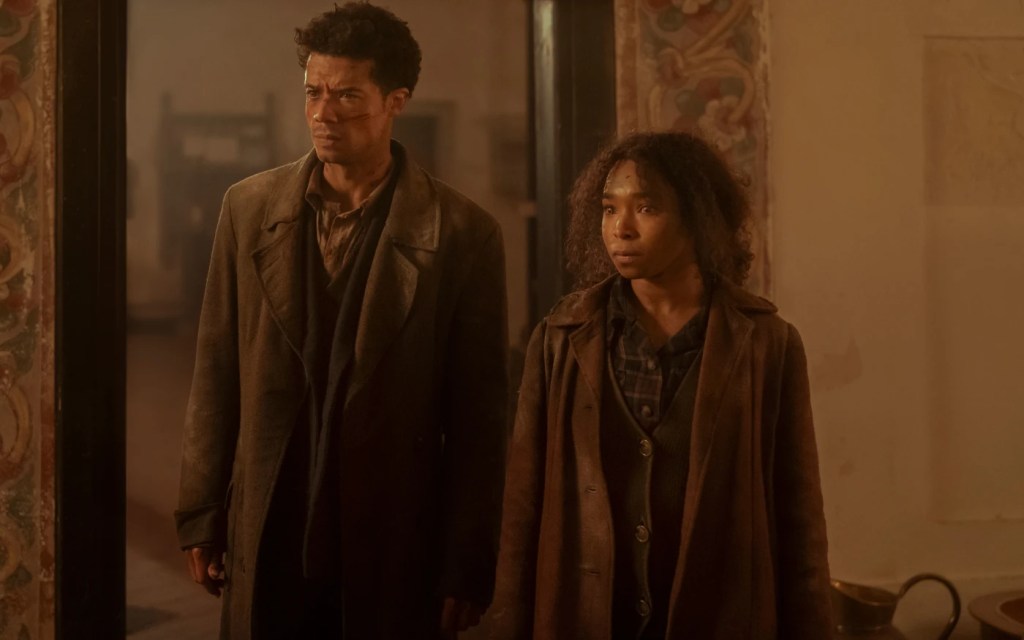
In the season two opener, “What can the damned say to the damned,” we find Louis de Pointe du Lac (Jacob Anderson) and the vampire Claudia (Delainey Hayles) struggling as they make their way through war-torn Eastern Europe, enduring constant air raids and run-ins with soldiers as the Nazi occupation of World War II is exchanged for Cold War Soviet omnipresence. But the unrest is not limited to the regime change of mid-1940s Romania, however; it extends to the relationship between Louis and Claudia who after the events of the previous season, have found themselves estranged from each other. In a heartbreakingly resigned voice, Louis in the present day reflects on this rift and Claudia’s determination to find other vampires and form community as she no longer felt that Louis “qualified” as someone who could understand her.
Estrangement and isolation are the major themes for our vampires in this episode, as Louis and Claudia, who exist within layers upon layers of marginalization and otherness, find themselves the subject of suspicion everywhere they go. From the interaction with the Nazi at the checkpoint who balks at them being Black Ukrainians to Blake Ritson’s Morgan Ward trying to catch Louis out as a secret communist, Louis and Claudia’s presence in Eastern Europe is constantly questioned. The two vampires are forced to play up stereotypes to make their way. Claudia pretends Louis is a “dumb” worker and herself a little girl to lower the Nazi’s guard. Louis plays up his drunkenness to avoid answering Morgan’s questions. Vampires are metaphorical outsiders in fiction and folklore, but Louis and Claudia were social outcasts before they were turned. Their vampirism just becomes another layer of their estrangement from humanity. It’s not a metaphor, it’s an amplifier making the themes of the story unavoidable.
Louis and Claudia were never going to have an easy time traveling through Europe, war aside. They’re Black Americans. Louis is a gay man, Claudia is in the body of a teenage girl. Louis has to pretend he’s searching for his wife, Claudia has to go play with the children while the adults talk despite being in her forties. And on top of all of the other pretenses, they’re vampires in a town that believes in the legends and protects themselves fiercely from the monsters who stalk the woods, lining their windows in garlands of garlic and hanging crucifixes from the walls. Every interaction with our vampires becomes charged with danger and the potential for violence against them.
In Allucquére Rosanne Stone’s book The War of Desire and Technology at the Close of the Mechanical Age (1995), she writes about the “vampiric body” and its relationship to what she refers to as the “wonder and terror of masquerade.” Stone is a trans woman and centers a transgender perspective, but the discussion of the natural and unnatural body is applicable to all who face oppression via biopolitics. She describes the natural body as “invisible, in the sense that as a cultural production it is unproblematic in its just-thereness” and that the “unnatural body” is a “screen, upon which is projected the war between natural and unnatural, speech and silence, monstration and effacement.” Louis and Claudia are unable to travel unnoticed through Europe, they do not have the luxury of the “natural body”, both in the sociopolitical and the supernatural sense. The vampiric body is that of a cyborg in the political sense, existing across boundaries both physical and cultural, and captures the “pain and complexity of attempting to adapt to a society, a lifestyle, a culture, an epistemology” that they don’t belong to. Claudia refers to Romania in her diary as their “ancestral home”, but neither Louis nor Claudia have any ties to the land beyond legends dug up in old books. Ultimately, they are looking for themselves in a history where they are not reflected in a country that regards them with contempt.
The section of the episode that most exemplifies to me the ostracization of Louis and Claudia is when they are brought to the factory with the other refugees by Emilia (Stephanie Hayes). Emilia is very pragmatic and empathetic, and when she notices the pointed stares of the other refugees, she tries to make light of it and assure Louis that it’s just because he’s so handsome. But both the characters and the audience understand the reason and if it weren’t clear enough, the show hands it to us explicitly by having one of the children call Claudia a racial slur when she asks about the game they’re playing. Our vampires are not welcome here, and as much as Louis craves human companionship after four lonely years with only a silent Claudia as company, he is quickly reminded that his presence in this place is tolerated but not accepted.
By the end of the episode, Claudia’s hope of connection with other vampires is completely dashed when the only lucid vampire they meet, Daciana (Diana Gheorghian), kills herself. They leave Romania dejected, beaten, and still very much alone. It’s at this point that Louis and Claudia realize that they cannot depend on the outside world, human and vampiric alike, to find their respective ideals to assuage their bone-deep loneliness; they have each other, and good enough is better than perfect. Louis promises Claudia that it’s her and him, and Claudia accepts this olive branch, taking hold of his hand as they enter Paris together. The resolution between them is heartfelt yet tenuous, but after facing constant rejection, prejudice, and exclusion for four years straight, Louis and Claudia decide that sticking together despite the bad blood (ha) between them is more favorable than continuing to try and make it through alone.
Works cited: Stone, Allucquére Rosanne. “Conclusion: The Gaze of the Vampire.” The War of Desire and Technology at the Close of the Mechanical Age, The MIT Press, Cambridge, Massachusetts, 1995, pp. 180–182.
 Two Goths and a Coffin
Leave a comment