“Like the light by which God made the world before he made light” Recap and Review: Spoilers Ahead
As we march on towards the season finale of Interview with the Vampire, the tone descends deeper and deeper into despondency as the storylines in both Paris and Dubai steep themselves further into explicit tragedy. In the sixth episode and thirteenth installment of the series, “Like the Light By Which God Made the World Before He Made Light,” the main word repeating in my mind was fractured, and it’s fairly obvious to see why.
The episode begins with two simultaneous scenes, the first with Daniel Molloy (Eric Bogosian), Real Rashid (Bally Gill), and the Talamasca agent, Raglan James (Justin Kirk), once again in the sushi restaurant that featured at the start of the third episode, “No Pain.” In this conversation, several discoveries are made, one of the most interesting being that Rashid is involved with the Talamasca in some capacity. This is a development that I had been anticipating after Daniel found himself with an enhanced recording of the 1973 San Francisco interview, but I was surprised to have it confirmed so quickly. The other is that the Talamasca wants Molloy to use a man on the inside, so to speak, and ask questions that serve their interests, whatever those may be.
The second scene is a very tense exchange between Louis (Jacob Anderson) and Armand (Assad Zaman) about what they should do with the large wall that previously displayed the imposing Francis Bacon triptych, Three Studies for Figures at the Base of a Crucifixion (1944). Armand in this scene almost seems to be pretending the implied confrontation at the end of the previous episode never happened, attempting and failing to maintain a casual air of nonchalance while Louis makes his resentment and anger plain as it bleeds into every snarky jibe and comeback, understandably unwilling to fall back into the hypnotic domesticity Armand desires. When Louis sarcastically suggests they display a collection of Fred Steins on the wall before finally saying, “Leave it bare then. Wait for revelation to enter the room” before leaving Armand alone, it immediately brought to mind their conversation in “No Pain” about Louis putting portraits up in his Paris apartment to “hide the cracks in the walls.” It appears that Louis is no longer interested in hiding the cracks.
In my recap and review for episode four, “I Want You More Than Anything in the World,” I spoke about Louis and Armand feeling distinctly at odds, and this episode is that but to the extreme. During Armand’s recollection of the vampire, Samuel Barclay’s (Christopher Geary) play, Enduring for Guido, a reference to Waiting for Godot by Irish playwright Samuel Beckett that is simultaneously on the nose and very effective, Louis continually interjects to contradict Armand’s account and point out his tendency to rewrite history to fit his narrative. However, unlike episode four, Louis and Daniel seem to have formed an alliance against Armand due to their shared trauma and memory tampering by his hands. When Armand begins to interrogate Rashid about Daniel’s movements outside the penthouse, Louis questions his motives and by doing so, points out just how extreme and obvious his desperate scrambling for control has become.
Speaking of the play within the play, Enduring for Guido is a particular point of interest for me personally. The staging, conceit, and costuming of the play are taken directly from Waiting for Godot, but a significant amount of the dialogue in the first scene we see is lifted directly from a conversation between Louis and Lestat from the Interview with the Vampire book right before Louis leaves and finds Claudia. Santiago’s (Ben Daniels) monologue comes directly from an excerpt after Louis and Claudia’s murder attempt, the monologue that includes the episode’s title. By placing these lines in an absurdist play, it highlights the philosophical implications of vampiric existence: how does one define meaning when faced with immortality? Can there be such a thing or does meaning require mortality to exist?
Furthermore, Santiago and the other coven members are using this play as a cover for conspiracy, and therefore, Enduring for Guido almost takes on a “The Murder of Gonzago” quality to it in the sense that the coven is using the production to “oust” the murderers in their midst. While Santiago recites his monologue, he telepathically instructs Estelle (Esme Appleton) and Celeste (Suzanne Andrade) to pry information out of Roget (Ed Birch) about his last correspondence with Lestat de Lioncourt (Sam Reid).
During the recounting of this moment in Dubai, Armand says, “In retrospect, the buffoon was in the audience, scribbling in the margins, oblivious to the conspiracy uniting around him,” and once again uses the third person to distance himself from the proceedings being described. Daniel called out Louis’ usage of this syntactic mode of speech in the previous episode but Armand had already employed this even earlier, in episode four, “I Want You More Than Anything in the World,” when telling his story in the museum.
In fact, Armand frequently uses language to distance himself from his history and his actions, and it becomes unignorable in this episode. He constantly deflects, shifts blame, and denies any statements that contradict his narrative, undermining Louis in such a way that comes across as him trying to paint Louis as being purposefully obstinate after the revelations of the previous episode. He uses every move from the gaslighter’s playbook, casting doubt every which way except his own. Unfortunately, Armand is very good at this and by the time he claims that Louis asked him to wipe his memories of those nights in San Francisco, even I was left wondering what the truth was.
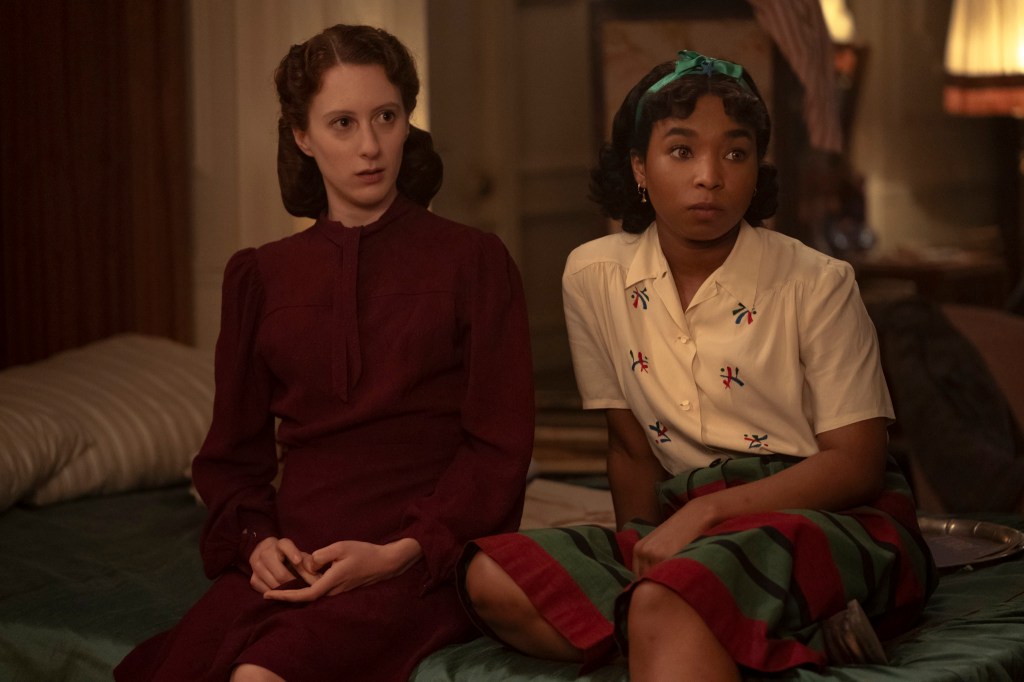
Moving along, Daniel notes that Claudia (Delainey Hayles) stopped writing in her diary after her relationship with Madeleine (Roxane Duran) progresses, her last entry stating that because she has a real friend, she has no need for a diary any longer. Claudia and Madeleine’s relationship and its progression are interesting, both on a textual and metatextual level. On a textual level, the specifics of their dynamic are left for us to wonder due to the fact that their development occurs off-screen. But looking at Claudia’s life and her desires, it makes sense that Louis knows so little about this development in her life; Claudia has never really had anything of her own, anything that’s purely separate from her connection to Louis and Lestat and I think the idea of not having to share this experience with anyone is very important to her. We saw this same sentiment back in the first season with Charlie, where Claudia closes her mind to Louis when he starts to pry. She even says in this episode that she wants to choose one thing for herself and it’s Madeleine as her companion.
On a metatextual level, I feel like having this relationship occur in this manner also solves time and budget issues for the production team. This is such a jam-packed season and this is a solution that makes sense both thematically, in the sense that any comments made on this subject are far more malleable now that there’s no corroboration from Claudia herself via her writing, and in terms of characterization.
What we do see of Claudia and Madeleine’s relationship, however, is very compelling. It almost feels like a complete inversion of Louis and Lestat’s romance in the pilot, the scene in the dress shop mirroring the church scene being the most obvious parallel. We get to have a glimpse of what a vampiric companionship might look like if both parties approached with kindness, understanding, and patience. Claudia takes time to reassure a shaken Madeleine after coming to her rescue, we see Madeleine reading Claudia’s diaries next to her as she’s curled up in Louis’ coffin, Madeleine’s decision to be turned is made with full knowledge of what it is that she’s agreeing to and completely willingly. With all this in mind, when Claudia states that she doesn’t want Lestat’s blood to be involved in this process, it feels like an attempt to break the cycle by rejecting the interference of her maker in any way, shape, or form.
This, of course, is thwarted when Armand refuses to turn Madeleine. Louis tries to use the dynamic they’ve established between them to coax Armand into agreeing, even framing Claudia as a burden that he will be free of if he does this, but after an interview with Madeleine, he declines. “Maître in the bedroom. Maître only when it’s hot or convenient”, Daniel says. Louis agrees with him, and Armand reveals that he’s never made a vampire before and even the idea repulses him. This forces Louis and Claudia into a difficult position: the only means left for them is to break one of the Great Laws and make a vampire on their own directly against the wishes of the coven leader, Armand. Another transgression added to their list of crimes to be used against them later.
Louis turns Madeleine and when he does so, he sees visions of her life and then a beautiful vision of Claudia from her point of view. This scene is so touching, as a character finally sees Claudia as she wants to be seen. The vision shows Claudia bathed in golden light wearing a yellow dress and one wonders if that’s why she keeps dressing Claudia in yellow, to find a way to swathe her in that sunlight.
The beauty of this moment fades as Louis faces the emotional repercussions of this action. He self-harms in an attempt to purge himself of Madeleine’s blood, and that’s where Armand finds him. Louis describes to him an all-encompassing emptiness and apathy that’s taken root after seeing Claudia and Madeleine off and notices Armand’s brought a suitcase with him. Armand apparently was given a “choice” with the coven in order to have a peaceful turnover of power in order to be with Louis. The details of this choice are left vague until they aren’t.
The episode ends with a double-date of sorts. Louis and Armand are meeting Claudia and Madeleine in a bar before the two women leave Paris together for good. Madeleine learns that fledglings and makers can’t read each other’s minds, but she can still feel Louis in an abstract way and flusters him by telling Armand that Louis loves him. Armand splits off from the pack and we see what exactly Armand bargained for in order to have Louis to himself. Louis, Madeleine, and Claudia are kidnapped by the theater coven and are dragged to a trial led by Santiago during a daylight performance. The final shot of the episode shows Lestat in the flesh in the theater dressing room being given his time until his cue to enter the stage.
To say a lot happened in this episode is an understatement. I could write for five more pages and still feel like I was missing crucial layers. Be that as it may, this episode feels like a perfect complement to episode six of last season in just how emotionally and thematically laden it is, specifically following a moment of abusive behavior. The path of the next remaining two episodes seems clear and the show is reminding us that while it can be fun, sexy, and wild, this is a tragedy and a horror show. I hope we’re all braced for what happens next.
 Two Goths and a Coffin